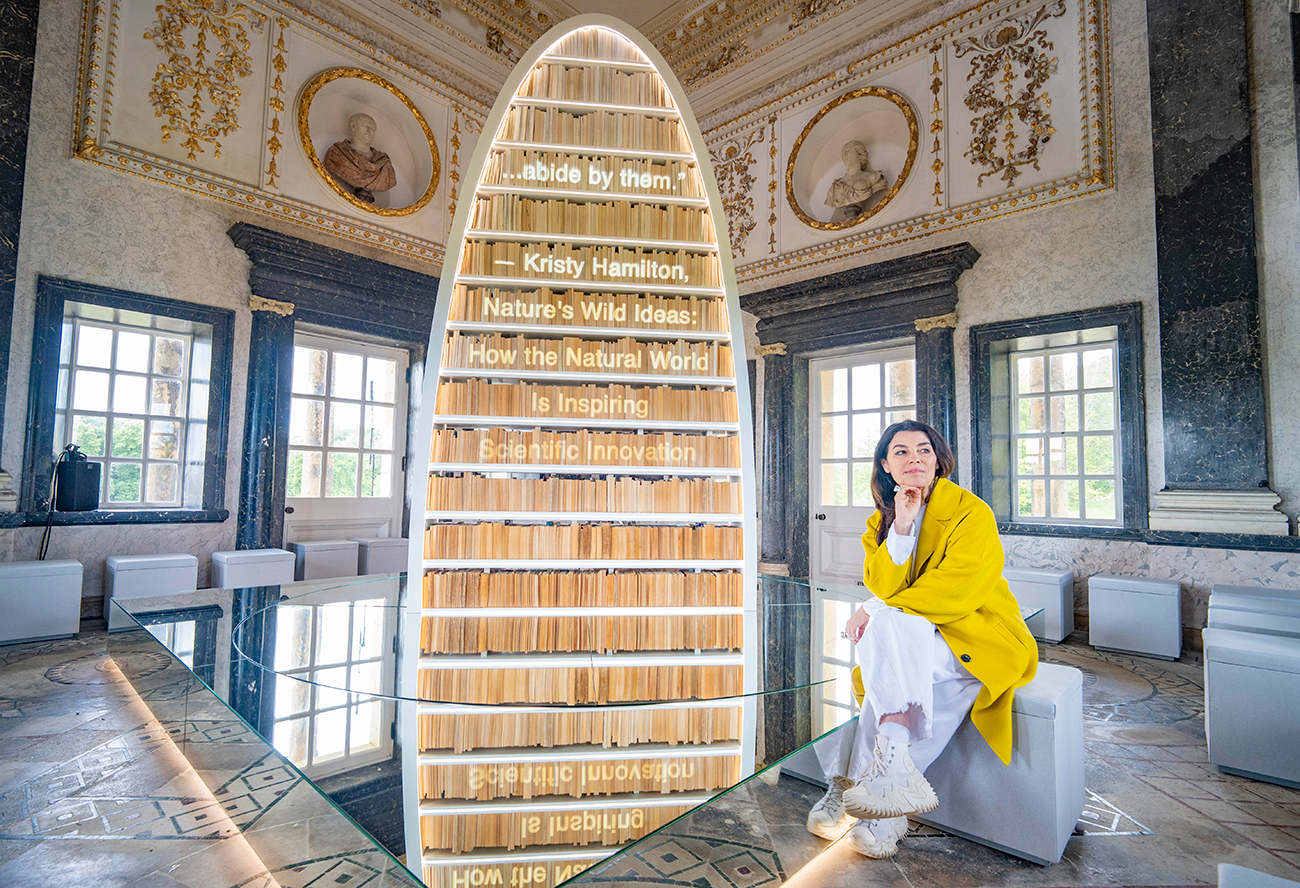
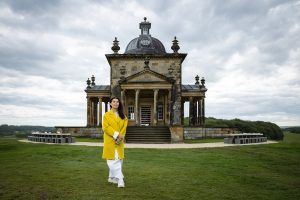
Es Devlin defies categorisation. An acclaimed artist, set designer and sculptor, her practice moves fluidly across disciplines, united by an enduring fascination with language, memory and collective experience. Her latest work, arriving ahead of her retrospective at London’s Design Museum, is Library of the Four Winds, the third iteration of her ‘library’ installations. It runs until 27 September at Castle Howard, the baroque masterpiece designed by architect and dramatist John Vanbrugh.
Here, Devlin has constructed a sculpture from hundreds of books drawn from her own shelves, in the service of what she calls an act of ‘collective reading’. The work is part of a wider cultural push to return to the page, midway through the National Year of Reading. The library invites visitors into a shared multisensory encounter with literature, accompanied by an immersive soundscape — meaningful passages read aloud by Devlin herself. We spoke to her about her more intimate work, and her commitment to nurturing a deeper culture of reading.
Jasmine Jackson This marks the third of your library installations, starting with Library of Us, set on the beach during Miami Design Week. How does it feel to now situate this work within the historically layered setting of Castle Howard?
Es Devlin It’s actually a first for me. I have not worked within a historic British country house. And to be working specifically in a pavilion that was really envisaged as a response to place, it really speaks to all the things I’m interested in, that John Vanbrugh was interested in. He really cared about the systems that underlie a plot in a play, the systems involved in running a theatre, in political activism and in architecture and landscape architecture. This is really an act of land art. And of course, he was a man of letters and literature, and this installation is made of all the books that have shaped my worldview.
JJ There’s something deeply personal about sharing books that have influenced your thinking. How do you see literature as a medium for sharing ideas?
ED I think we all suffer from not reading enough. The statistics around reading are pretty drastic. I started noticing it about 10 years ago — that I just wasn’t reading the way I used to, it wasn’t therapeutic to me the way it used to be. So I wondered whether we could do reading as a collective act. Since 2018, I’ve been exploring that, and what we remarked — even with the first audience here — is that people really fell under its spell. Sitting together, agreeing to not switch on the phone, you could see people were relishing that.
JJ The work seems to ask for a certain level of time and attention. How do you navigate that in such a fast-paced, distracted world? Has that been a challenge in presenting the work?
ED What this artwork is asking of people is a very tiny amount of time. These are only small nuggets, tiny phrases that express an awful lot. It’s almost like the greatest hits of reading. It’s a way of luring people back into wanting more, but also a way of cultivating your own interior landscape. I think we do suffer from a crisis of loneliness, and this is a way that people who are strangers will experience that community of all being enlightened by one great author’s text at the same time. It’s an art installation, but it’s also a meeting point and a place of encounter. Those who come become part of the artwork.
JJ Could you talk about how you approached curating the library?
ED I’ve been building this work really since 2016. I’ve chosen books that have shaped my perspective. When [Jorge Luis] Borges said, ‘I am all the writers that I have read,’ I do believe that to be true. Every book you read actually changes the architecture of your brain. New synaptic pieces of architecture are forged. So I’ve chosen the books that I’ve learned the most from.
JJ You describe the work as a form of ‘collective reading’. How important is that sense of shared experience to the installation, and what do you hope people take away from reading together in this way?
ED For this work, there’s a sense of urgency because it is the National Year of Reading. There’s a combined emphasis around the country on drawing people’s attention to just how medicinal reading can be. The invitation is for people to come on a beautiful summer day, to sit at the table, read a bit of a book, maybe talk to a stranger and leave traces of encounters with one another. I really hope that it’ll provide seeds for creating encounters between people.