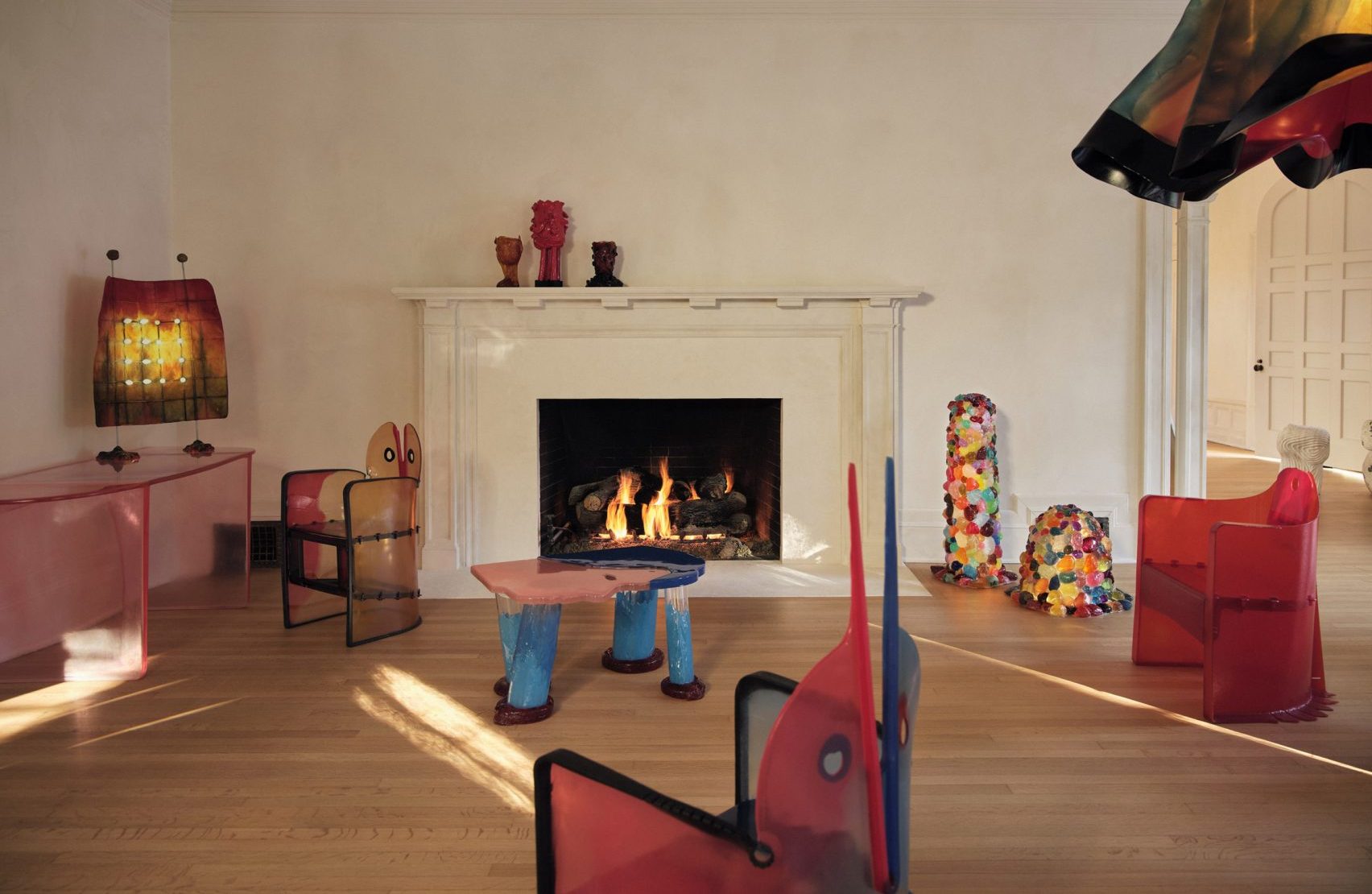
For Gaetano Pesce, architecture and objects were opportunities to express individuality, embrace imperfection and reflect the complexity of human life. Colourful, experimental and often provocative, his work blurred the boundaries between practices, challenging the idea that our environment should be predictable.
Born in La Spezia, Italy, in 1939, Pesce spent more than six decades questioning the conventions of modernism and developing a playful, political visual language. He resisted standardisation, believing that objects should reflect the individuality of the people who make and use them. After studying architecture in Venice, he became associated with the experimental Radical Design movement. In 1983, he moved to New York, where he continued his work.
Materials were central to his approach. He experimented with polyurethane foam, resin, rubber, PVC, metals, wood and textiles, exploring how they could bend, sag, stretch and drip. Their unpredictability was part of his philosophy — Pesce used these qualities to challenge the idea that production had to result in uniformity. Best-known works like the UP5 chair drew on the human body to explore ideas about women and society. Later projects like Nobody’s Perfect embraced the beauty of difference. They are still so important today because they were about challenging boundaries and unapologetic experimentation.
It’s these ideas that make his work so compelling for contemporary galleries and interior designers. At PAD London in 2025, Paris-based Pulp Galerie presented an exhibition devoted exclusively to Pesce’s designs. ‘What makes Pesce’s work so fascinating, and what continues to captivate us today, is both the extraordinary diversity of his creations and the constant spirit of experimentation that drove him throughout his career,’ says co-founder Paul-Louis Betto. ‘Pesce was a pioneer and a free spirit, constantly challenging established conventions. A profoundly humanist designer, he continues to fascinate us more each day through works that feel vibrant, expressive and full of life.’
For those who want to see his work beyond the screen, we’ve laid down five routes.
Pulp Galerie, Paris and New York
An important destination for the Pesce-curious, Pulp specialises in radical, sculptural design that blurs the boundaries between furniture, art and architecture — shown outside the traditional museum context. Its Pesce selection spans different periods of his career — including the Nobody’s Perfect series, Greene Street chair and Broadway series. It has also explored the architectural dimension of Pesce’s practice. ‘Little by little, we discovered the rest of Pesce’s work and became fascinated by his experimental approach, his exploration of new materials, colours and forms, and his use of anthropomorphism,’ says Betto.
Last spring he revisited the designer’s Chiat/Day New York office project through surviving furniture and architectural elements. ‘Alongside the exhibition, we published a book retracing the project in its entirety, bringing together sketches, interior designs and an extensive selection of archival photographs… All of these exhibitions, research projects and publications have progressively established Pulp Galerie as a major reference for [his] work.’
’Suivez le Fil!’ at Hotel des Arts, Toulon
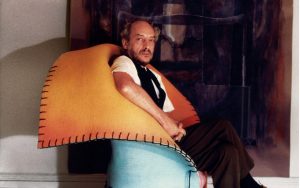
In 1996, the Centre Pompidou presented ‘Gaetano Pesce: Le Temps des Questions’, a pivotal retrospective that explored his contribution to art, architecture and design. Today, the museum’s collection includes several significant works by Pesce, among them the Feltri chair, designed for Cassina in 1987. With the Pompidou temporarily closed, much of the collection is touring neighbouring institutions and Pesce’s chair is included in the exhibition ‘Suivez le fil!’ at Hotel des Arts in the south of France. The showcase, on until 31 October, explores the relationship between craftsmanship, technology and traditional textile-making. Made from thick felt, with a rigid lower structure and a flexible, enveloping back, the Feltri is a striking example of Pesce’s ability to transform an unconventional material into a functional yet sculptural artwork.
‘A Chair Is a Nest…’ at Salon 94, New York
On view until 24 October
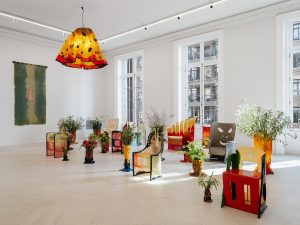
Spanning several floors of Salon 94, ‘A Chair Is a Nest, Is a Foot, Is a…’ brings together archival works, offering a glimpse into Pesce’s imagination. Curated by artist Anthea Hamilton, the exhibition includes UP7 (1969) and Tramonto a New York (1980) alongside original drawings and prototypes. The juxtaposition of finished pieces with works in development creates a dialogue between possibility and realisation, showcasing the ideas behind the objects. On the third floor, ‘Gaetano Pesce Studio: Continued’ celebrates the ongoing work of his eponymous studio with an installation of newly fabricated pieces. Together, the presentations offer an opportunity to consider both Pesce’s legacy and the ways in which his practice continues.
180 The Thames, London
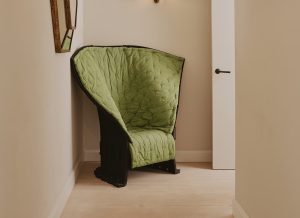
Pesce’s designs have been integrated by interior designers into some of Europe’s most whimsical contemporary residential interiors. In the River Loft at 180 The Thames in London, the interior-design team of Eagle + Hodges included a green-felt version of Pesce’s 357 Feltri chair in the entryway. The iconic 1980s piece is an expressive example of Pesce’s approach to furniture, with a high, enveloping back that gives it the appearance and feel of a cocoon — somewhere between an armchair and a piece of soft sculpture. Its stiff base cedes to the pliable upper structure, creating a sense of movement and softness. The form of the chair has an architectural quality — it creates a small, intimate space around the sitter and highlights how Pesce’s designs often express fluidity and motion.
The Organic Building, Osaka
View this post on Instagram
One of the most exciting ways to experience Pesce’s ideas at an architectural scale is at this building in Osaka, completed in 1993. Designed as offices for the food company Oguraya Yamamoto, the nine-storey block is distinguished by its vivid red-orange façade and exterior planters. Developed as a vertical garden, the building brings vegetation into the densely urban environment. Its expressive irregular exterior details reflect Pesce’s resistance to uniformity, while greenery emerging from the architecture demonstrates his interest in the relationship between the built environment and nature. It offers a striking example of how his experimental approach extended beyond furniture and interiors to the city itself.