
At nearly 50, Cassina's Cab chair is a stealth staple of interior design
It's a rare classic that goes with everything

Mario Bellini was working as an architect for nearly 20 years before he found, he says, ‘the courage’ to design a chair. Why so hesitant, when so many of his creative countrymen were dashing toward chairs as the purest distillations of their talent. Gae Aulenti had one; the artist Joe Colombo was a passionate designer of seating. And of course Bellini, like Gaetano Pesce, was an architect first — surely he had an edge on the complex angles and curves that make a chair a not-so-straightforward production. Indeed he believed that ‘to be a good furniture designer, you have to be an architect — everything meaningful that’s been designed has been by meaningful architects.’
By the mid-1970s Bellini was finally ready to play. In his mind was a model of skin and bones: hardly a tendon or muscle beyond a simple steel skeleton wrapped in tanned hide. Bellini’s frame would be bent into a structure like the ones prototyped by French architect-designers like Le Corbusier and Charlotte Perriand 50 years earlier. And the leather dermis would be a deceptively complex organ that moved with the user’s body ‘in a structural and organic symbiosis’.
With backing by Cassina, the Lombardy-based manufacturer that essentially pioneered industrial design in Italy, Bellini debuted his Cab chair in 1977. The leather upholstery was a synergy between 16 parts, each fleshed, thinned, die-cut and hand-stitched — a human touch. The upholstery was moulded to the skeleton like bespoke suiting, and rather than use studs to fasten it, Bellini inserted zippers along the inner legs and beneath the seat, which allowed it more leeway to bend and hug the sitter. Cab was the first ever chair to feature a free-standing leather structure, now ubiquitous. As with a leather jacket, the Cab’s jacket only improves with age.
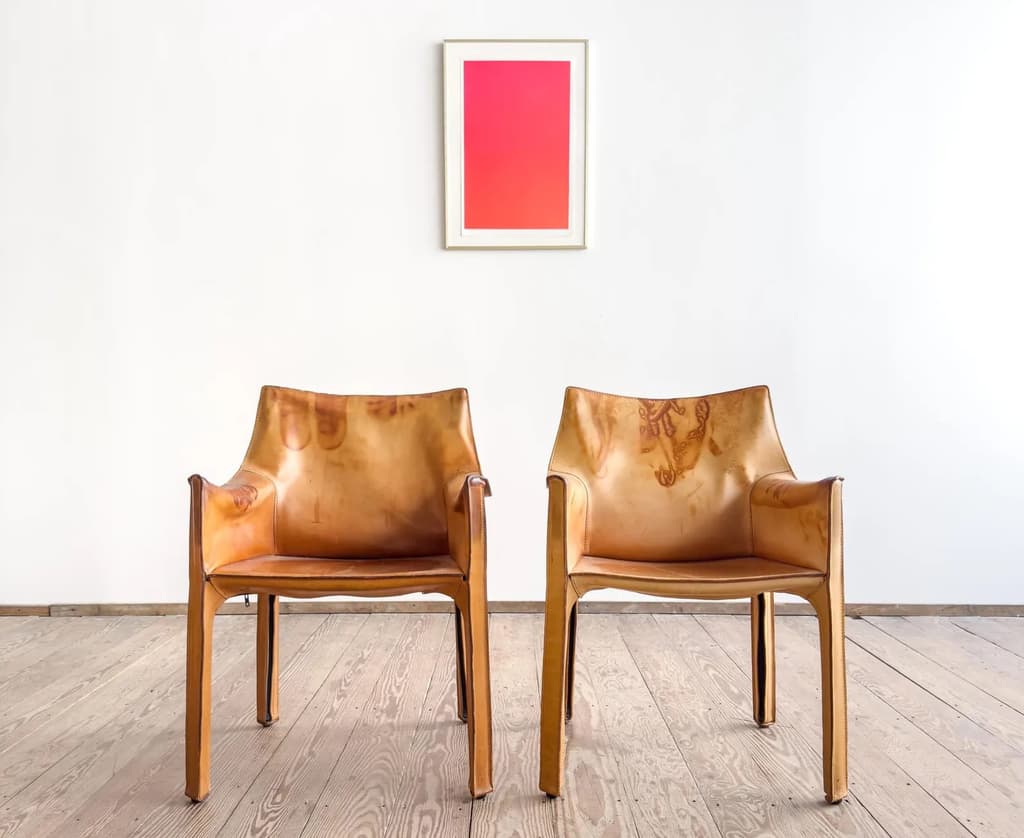
The zippers made the saddle hide easily removable, too, so it could be restored in its old age. Unsurprisingly, a robust vintage market has formed around this stealth staple: collectors and interior designers seek it out by the dozen for residential and commercial use. Plenty of copycats have had a go at the classic design — Bellini himself called it ‘much cloned’. Yet you really can always spot the real thing by the handcrafted edges and high-quality leather. Part of MoMA’s modern-design collection, it remains a bestseller for Cassina nearly 50 years into its life — and a signature piece in the ‘I Contemporanei’ compilation.

The Cab kept Bellini in the Cassina stable for decades. Its understated charm and enduring profile makes it a standard bearer for Italian modernism of the latter 20th century — the Platonic ideal of a chair. In its easy form you can see the clean lines of Italian PoMo design, the supple leather seats of the Maserati and Ferrari, the sharp tailoring of an Armani suit. And at the end of the day it simply makes you want to stick around.
Read next: Gucci Design Ancora remixes 5 Italian classics
Bottega Veneta redesigns its Paris flagship as a glowing glass and wood box
Related stories

Newsletter
Want news delivered to your inbox?