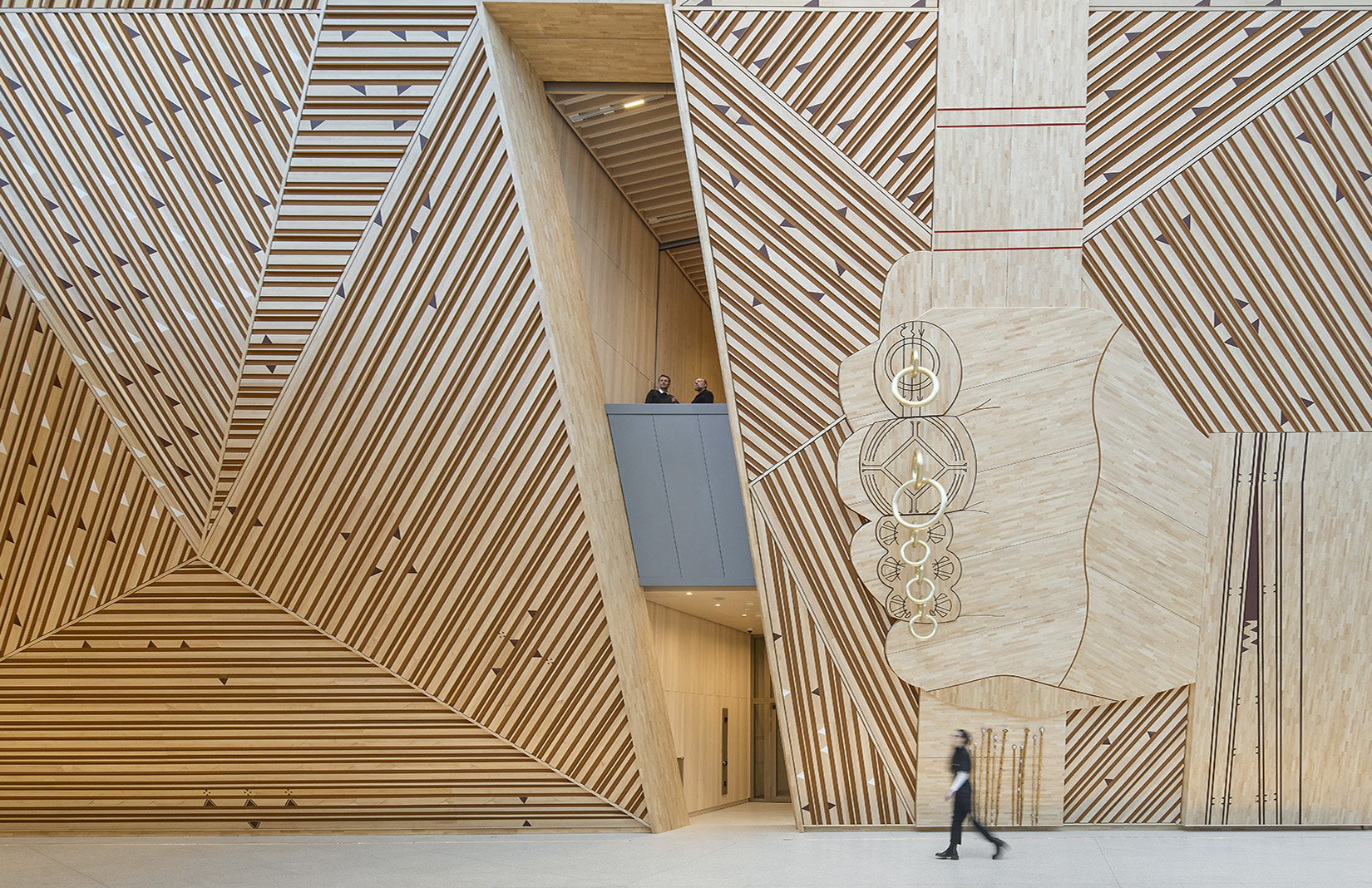
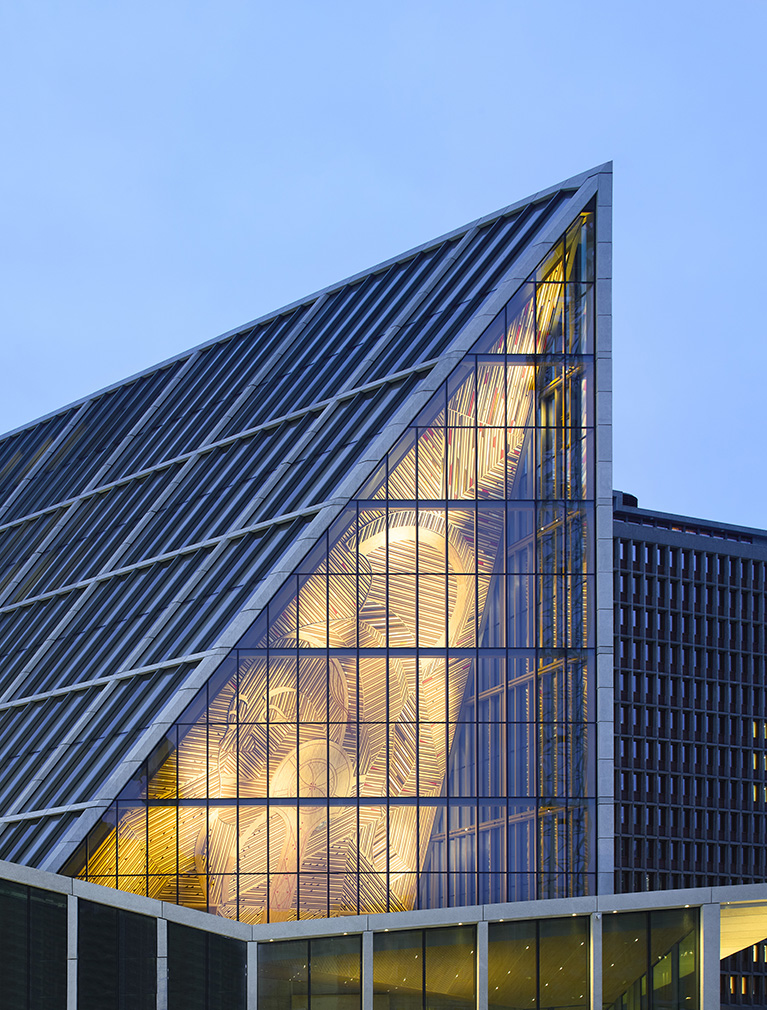
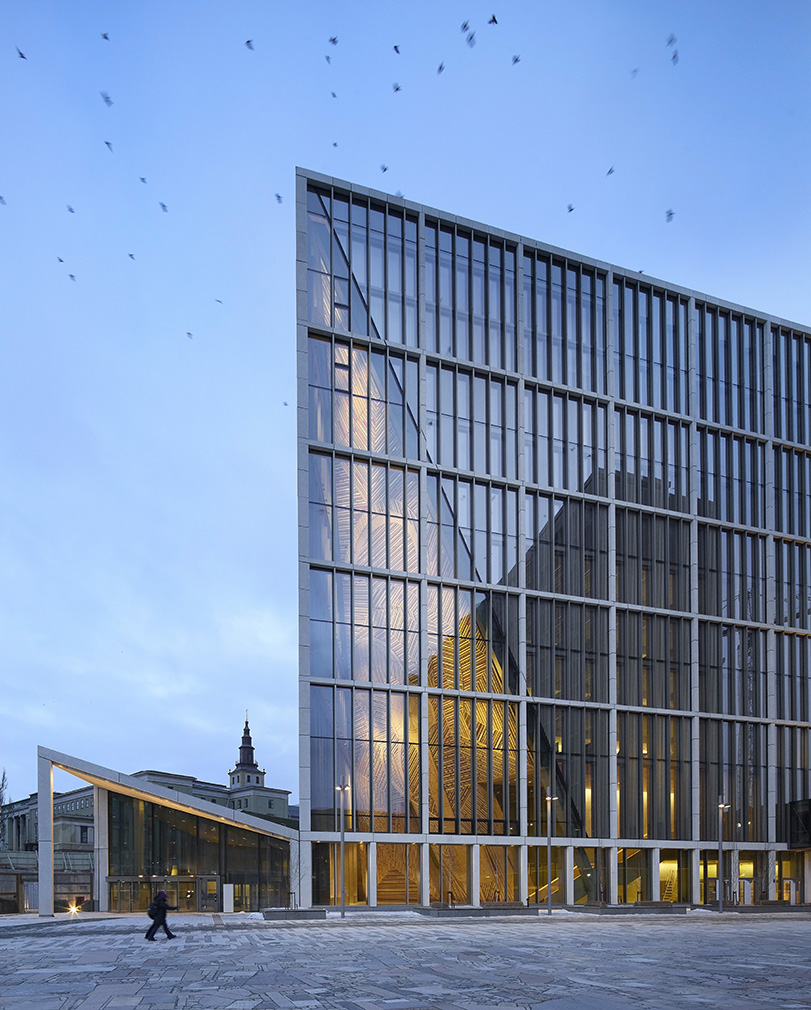
The new faceted glass structure rising from a network of lawns and mosaic pavements is an ethereal beacon in central Oslo. Almost completely transparent, from its tetrahedral roof down through to a skeleton of Nordic birch and stone, it absorbs sunlight by day and glitters with designer lighting by night. Cyclists and pedestrians who cut through the courtyard on their journey through town can stop to admire the 700-square-metre artwork in the pyramidal glass foyer — a timber woodcut mural by the Sámi artist Outi Pieski.
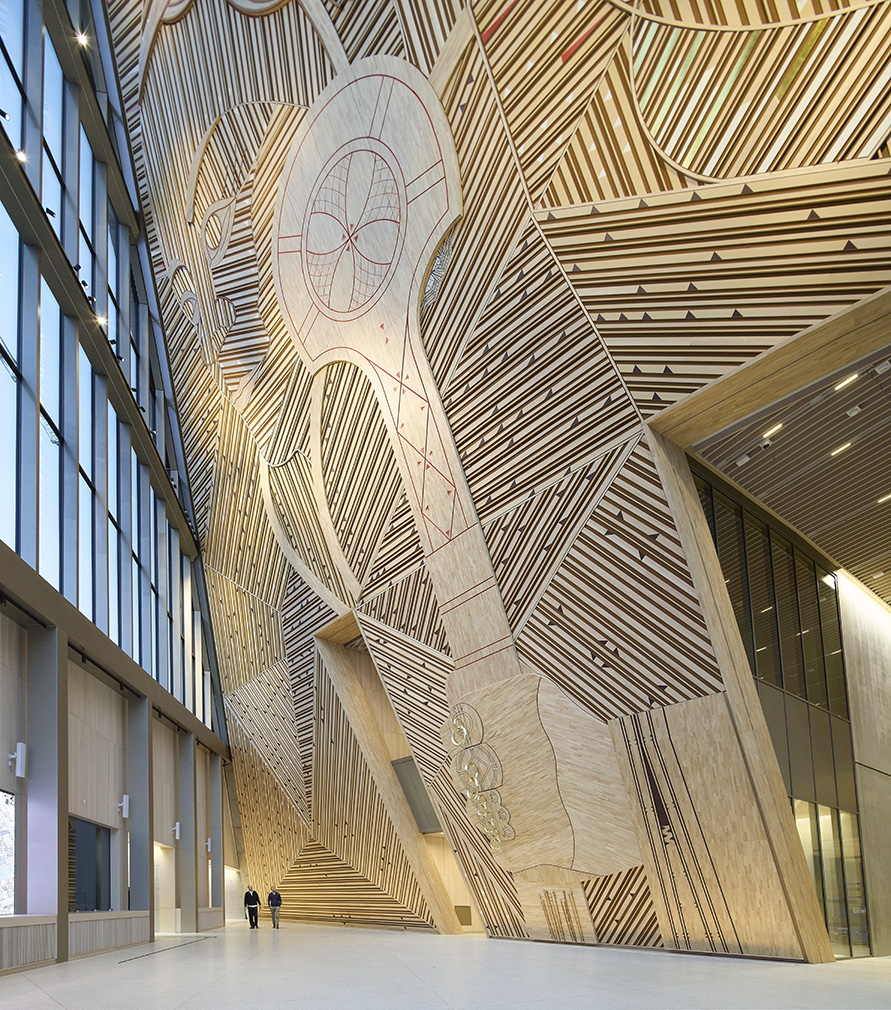
One of a clutch of buildings forming Oslo’s New Government Quarter, it was designed by Nordic Office of Architecture with Haptic Architects for maximum impact belying its utilitarian name: A-Block. Yet even routine visitors to the city are unlikely ever to have visited this 25-acre site, barely 10 minutes’ walk from anywhere in town.
A-Block’s opening this month comes nearly 15 years since a local radical detonated a bomb a few steps from here, killing eight people and destroying a significant chunk of the government’s nerve centre. (His subsequent killing spree, on the nearby island of Utøya, devastated the nation and the wider world.)
‘The national trauma is still with us,’ says NOA’s founder, Gudmund Stokke.
The immediate response, he says, was lockdown, security barriers, closed streets. ‘But a monumental speech by [prime minister Jens] Stoltenberg a few days later called for more openness, more democracy. Implementing those words into the scheme became a leading light for our work.’
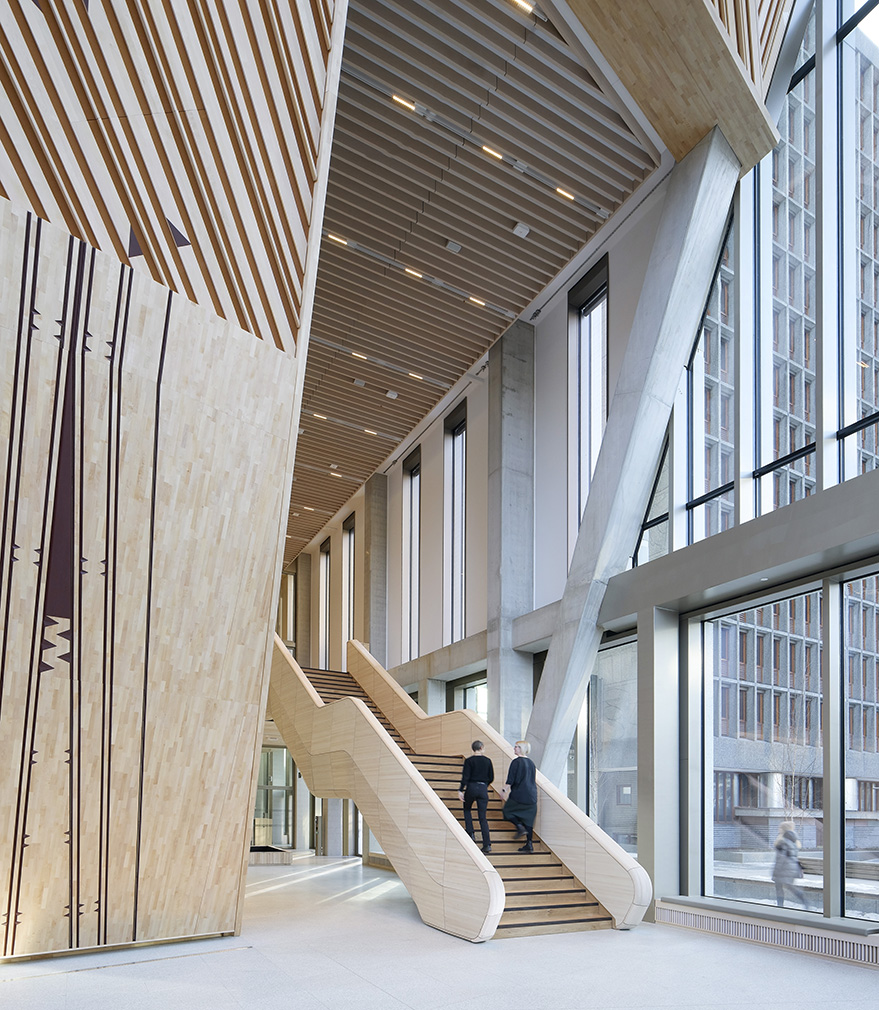
Over the 20th century, indiscriminate building had closed off the area from the city fabric; the east-west connection was, says Stokke, ‘nonexistent’. Today the state’s impressive collection of art can be glimpsed by the public from a vast courtyard ‘carpet’ composed of decorative stone fragments from across the nation — the work of Jumana Manna — and 50,000 tiny bronze figures by artist Do Ho Suh. They can see through to A-Block’s sweeping birch staircase, fabricated by Norwegian boat-builders. And they can admire the multi-storey ‘The Fishermen’ mural, etched into a massive concrete wall by Carl Nesjar in 1970, to a drawing handed him by Picasso. The mural avoided the damage that befell its original building, and was arduously repositioned onto the facade of A-Block last year. The glass lobby was built to accommodate it.
Photography: ©Hufton+Crow.
Photography: ©Hufton+Crow.
Photography: ©Hufton+Crow.
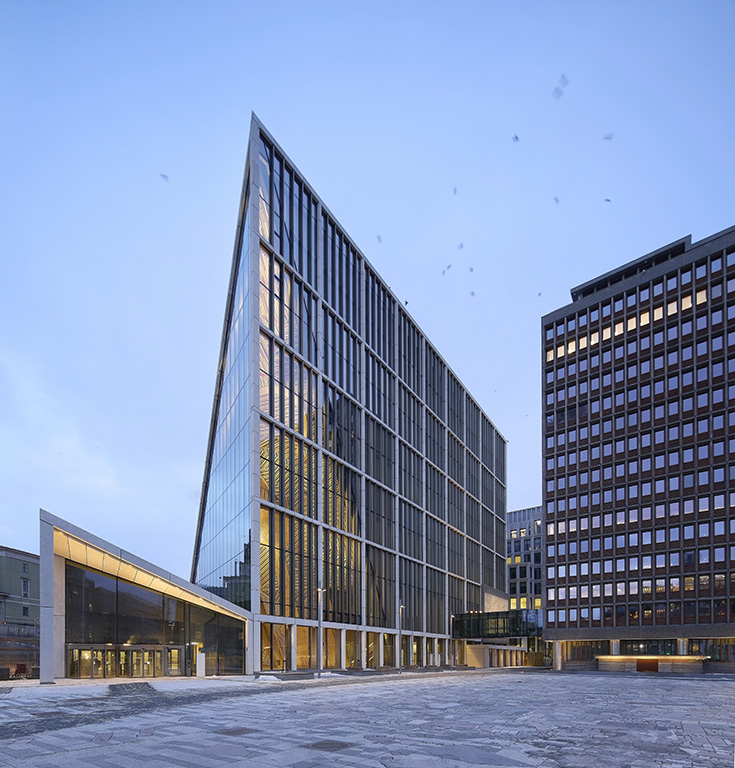
A-Block at the New Government Quarter in Oslo. Photography: ©Hufton+Crow.
Photography: ©Hufton+Crow.
Photography: ©Hufton+Crow.
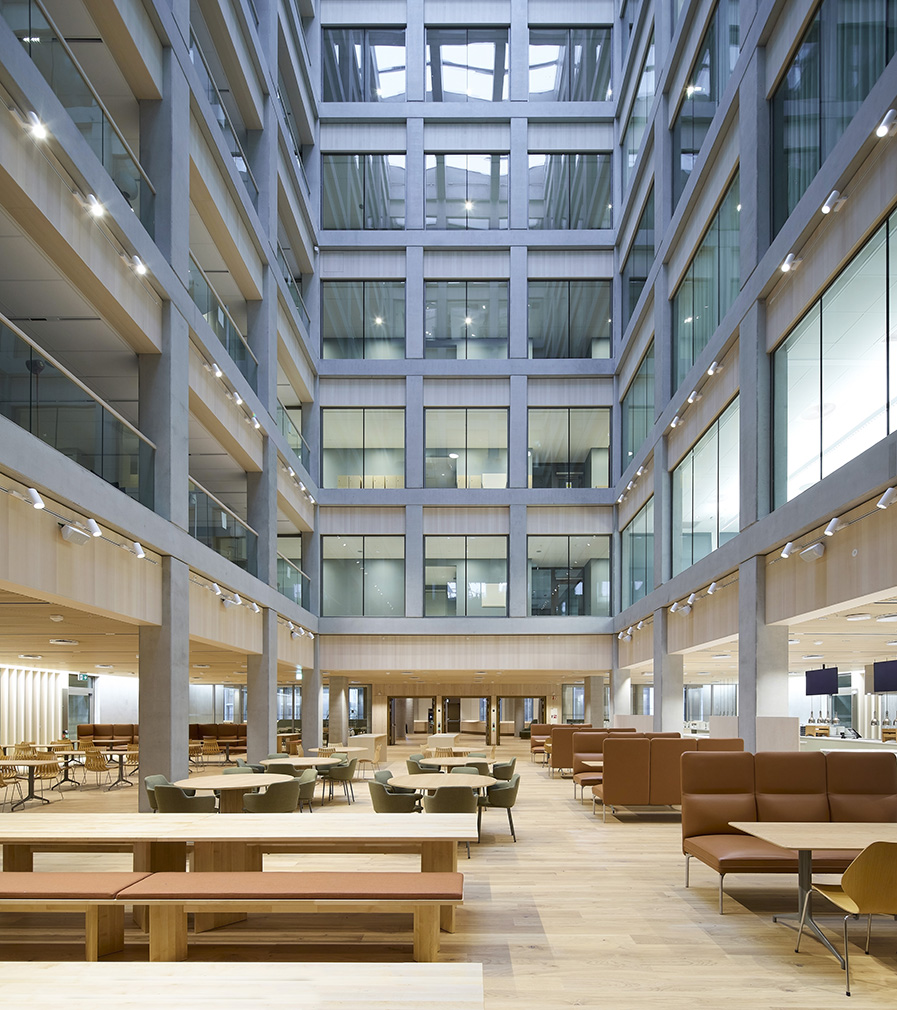
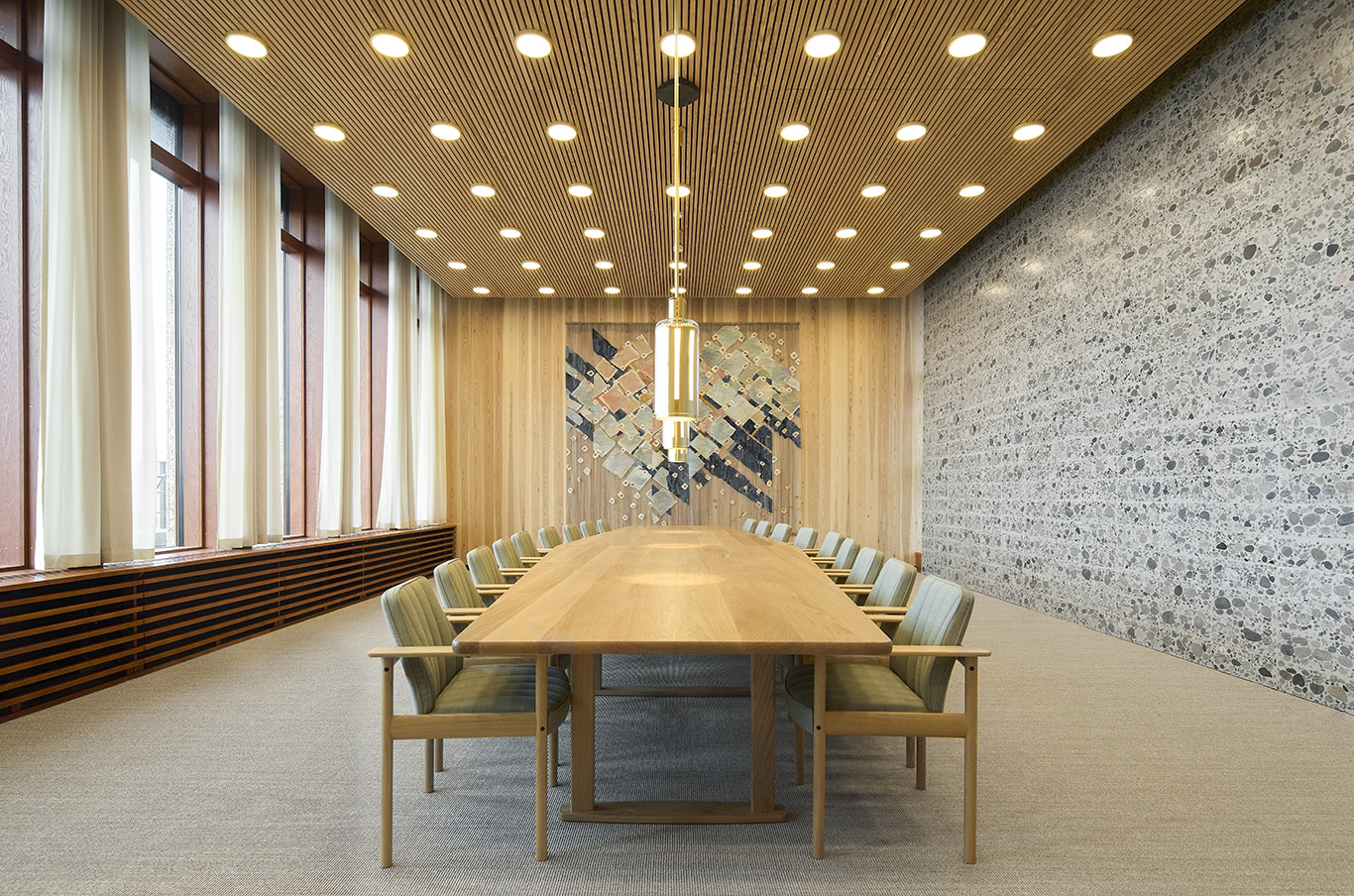
This is Norway’s ‘new face of democracy’, says Stokke, sharply angled to divert arctic winds and allow sunshine into the adjacent park, part of a wider landscaping project by Bjørbekk & Lindheim and SLA. In the wider plan — a high-stakes, high-complexity, high-security scheme — every component is symbolic. Seven buildings hosting some 4,100 people are connected by glass bridges: more transparency. Floors are laid in slabs of local stone or terrazzo aggregated from it. Rooms are furnished in Norwegian oak, with 20% of all pieces reused from defunct government offices. Even the heating is generated from the Oslo fjord.
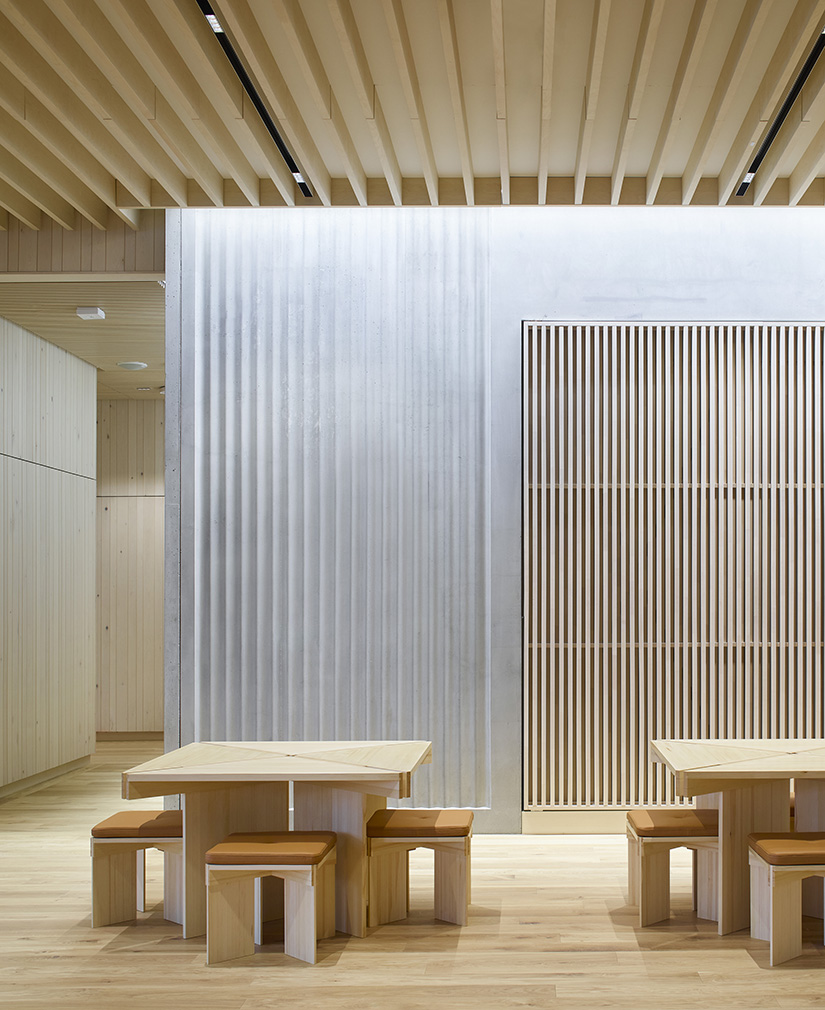
Conceived by NOA alongside interior architects Scenario Interiørarkitekter, I-D Interiørarkitektur og Design and Rambøl, the common thread among the interiors is ‘subtlety with detailed materiality’, according to NOA partner Knut Hovland. He points out furniture with chamfered edges to match the window surrounds, and concrete panels impressed with unusual fluting. ‘The precast concrete panels don’t read brutal, so they’re not overwhelming,’ he says. ‘The feeling is considered and seamless.’ The roomy four-metre ceilings are ‘more sustainable’, he says, in part because they draw in more light.
At the centre of the Quarter, says Hovland, is the ‘concept of the public square, formed by three iconic buildings’. These are the still-standing ministry of finance, built in 1906; the 1958 Høyblokka building, gutted by the bomb; and the new A-Block. In summer a new pavilion will be inaugurated to rehouse the ’22 July Centre’, the city’s memorial museum. And a commemorative public art work by Venice Biennale veteran Matias Faldbakken — called Upholding — will be in unveiled. Faldbakken, who won a national competition to take the honour, responded with a 12m mosaic ‘canvas’ featuring natural themes from Utøya island in 500,000 fragments of stone. It will be propped up in the same kind of steel girding that safeguarded the etched-concrete Picasso for so many months. The names of 77 victims will be carved into the steel.
The architects have made much of the Quarter’s sustainable credentials — it achieves Norway’s highest BREEM standard, delivers new urban parks, green roofs and native plantings to the site. Durability and endurability are themes preoccupying most architects these days — not least from Norway, a global hero in renewable power. The greater challenge, for all Norwegians, has been personal resilience in the face of disaster and a polarising geopolitical reality. The official opening for the 22 July Centre will put them, and Norway’s new political centre, on display. And it should go some way toward piecing back the fragments of a broken people.